
There was a band of brothers … and a band of sisters.
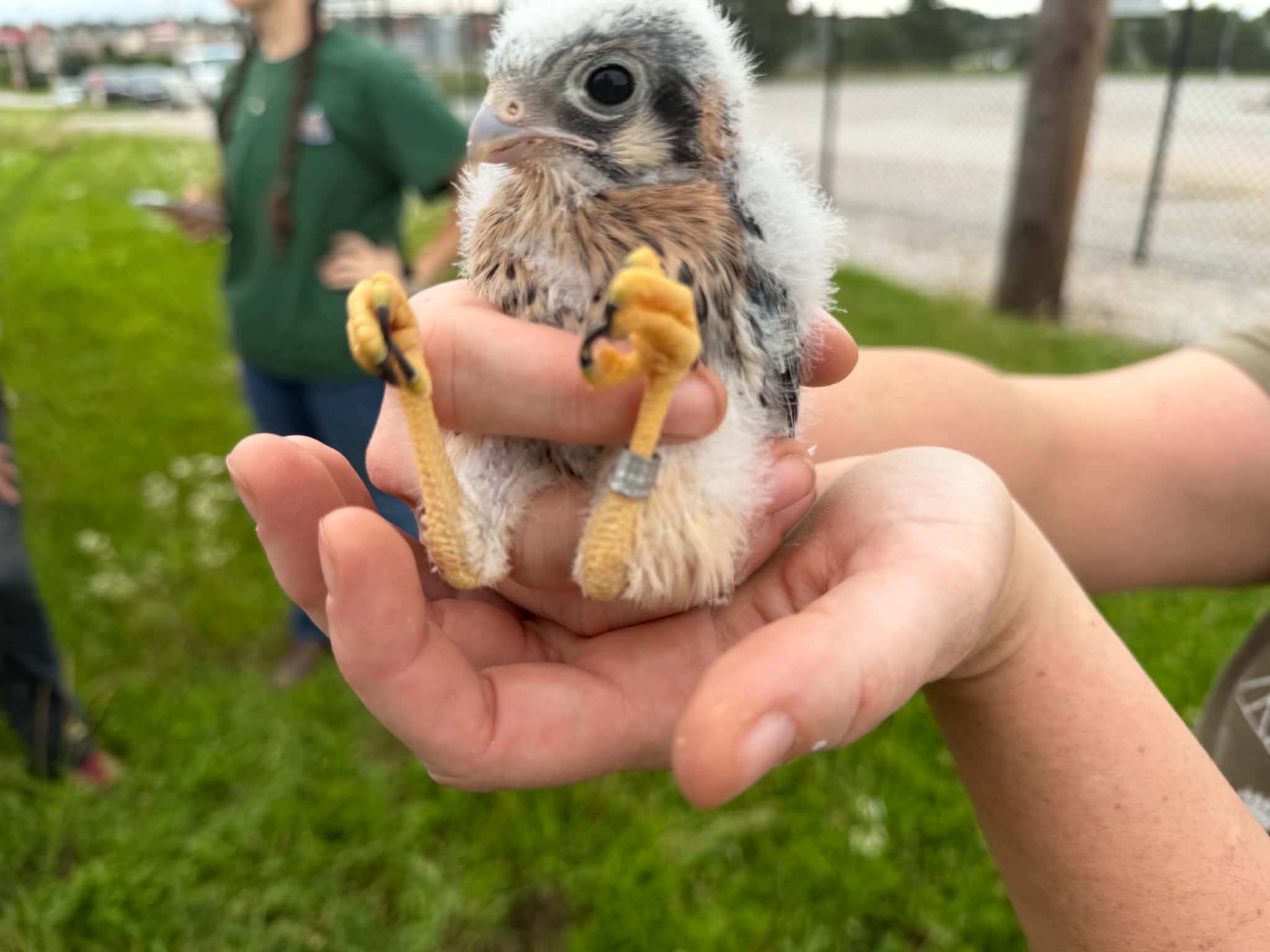
Standing atop a ladder to reach the kestrel nesting box mounted on the utility pole, Meagan Duffee-Yates removed four chicks and placed them in a container.
“Two boys and two girls,” she said, carrying the container to the bed of her truck. “Two and two.”
A Private Land Conservationist with the Missouri Department of Conservation, Duffee-Yates then demonstrated the process of attaching a small band to one of the legs of each kestrel. Banding birds can provide valuable data for conservationists, including helping to track migration, monitor population health, and protect endangered species.
For the past six years, Liberty has partnered with the conservation department to host a kestrel box at one of its local substations.
“Meagan reached out to us about putting up a kestrel box at a time when we were having starling issues at our substations,” said Jason Grossman, Liberty’s Manager of Vegetation Management.
Flocks of starlings that decide to roost at an electric substation can cause serious issues. Whether nesting inside of sensitive equipment or causing overhead lines to be weighed down or even bounce, the small birds have the capability to create customer outages.
“When they knock out a substation, it can impact 500 to 5,000 customers at a time,” Grossman said.
“When Meagan contacted us, we looked at the kestrels and saw that small birds were a main part of their diet and decided it would be a good thing to test a natural solution at our substations that could help improve reliability.”
Grossman and other Liberty personnel would later build six additional kestrel boxes to place at substations in Liberty’s Missouri and Kansas electric service area.
Duffee-Yates said that kestrels can feel right at home when nesting near substations.
“Substations have such low vegetation around,” she said. “It’s great for the birds because it helps them find insects and mice. It’s also a very wide-open space, so there’s less of a chance of them being eaten by predators.”
While electric utilities can benefit from the presence of kestrels, banding the birds serves another important function, Duffee-Yates said.
“American kestrels at a nationwide level are in severe decline,” she said. “About seven years ago, I decided I wanted to start putting up boxes to monitor their population. I have two boxes – one here (in Joplin) and another in Barton County – which lets me see the difference between boxes placed in urban versus rural areas.”
The Joplin kestrel box has been in place for nearly six years. Duffee-Yates said she’ll start checking the boxes in February.
“Once I start seeing the box is in use, I’ll come check every two or three weeks,” she said. “Kestrels can migrate, but I think my adults have an established territory because I’ve seen them using the same box as previous years. I haven’t had any band returns yet on the chicks. It’s either a good or bad thing … they’ve gone off and dispersed or they’ve passed away somewhere, and nobody has located the band.”
Duffee-Yates says the conservation department has also placed a nesting box for peregrine falcons at one of Liberty’s power generation plants. Like starlings, the falcons can help control pests around industrial sites.
“We haven’t seen any of the falcons yet,” she said. “But fingers are crossed!”