It may not be as exciting as a new business coming to town (we heard that was the word on the street), but there’s something to love about updating a wastewater system so it can handle the job (let’s just say the alternative stinks).
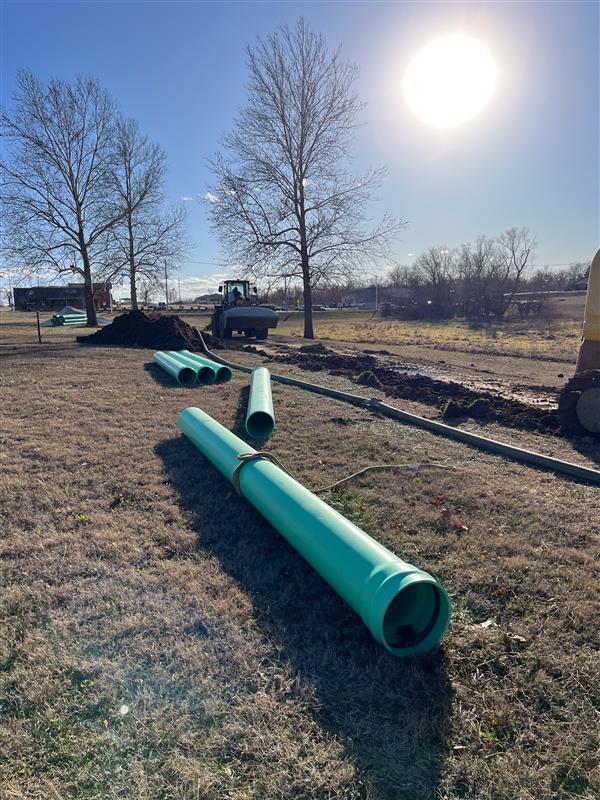
That’s what Liberty crews and contractors focused on throughout 2025. That means stacks of new green PVC pipes, heavy equipment, and digging were a common sight throughout the Bolivar, Missouri, community.
While this more visible indication of Liberty’s commitment to improving the city’s wastewater system recently wrapped up, work on this long-term project continues behind the scenes.
“We’ve met with the Missouri Public Service Commission, the Office of Public Counsel, and Bolivar city staff to update them on plans for the system,” says Eric Larsen, Liberty Senior Manager, Capital Administration and Planning.
“We’ll continue to keep our stakeholders – including our customers - updated on this important multi-year project.”
From the beginning
When Liberty purchased the wastewater system from the city of Bolivar in 2022, the immediate concern was to address sanitary sewer overflow (SSO) events that had been flagged by the Environmental Protection Agency.
The first step was to pave the way for Liberty to legally operate the system, which meant coming to an agreement with the Missouri Department of Natural Resources (DNR) on how to bring the plant into compliance. That agreement established parameters for operations and addressing the SSO issues.
An initial engineering study in 2024 resulted in a facilities plan with a price tag of about $100 million – not a viable option for a city with 5,000 customers. That plan called for updating the plant to handle 14 million gallons of wastewater per day, when the average amount of wastewater moving through the system is under 2 million per day.
We went back to the drawing board to find a more cost-effective solution. This meant taking a deeper look into the root causes of the SSO events within the city.
Inflow and infiltration – indeed
That investigation started by checking the integrity of the pipeline that carries wastewater to the treatment plant. This process is called “smoke testing.” We began smoke testing in the summer of 2024 and again in 2025, which involves introducing non-toxic smoke into the wastewater piping system to find leaks or cracks where stormwater and groundwater were entering.
“We found a three-way manhole that had collapsed and a lot of small issues that we were able to address, but weren’t finding a smoking gun,” Larsen says (pun intended).
Coordinating with the water operations team, however, helped unearth a major culprit: aging clay pipes.
Decades ago, at the time the Bolivar wastewater system was built, the standard material for sewer lines was clay pipe. It was installed in short sections, meaning it had plenty of joints.
The issue with clay pipe is that as it ages, cracks can form in the seams of the pipe. Rainwater, for example, finds its way through the dirt and runs straight into the pipe seam. PVC has been the material of choice since the mid-1970s.
Water that seeps through the cracks and joints of piping is known as “infiltration,” while water that flows directly into the system is “intrusion.” The two issues – called “I&I” within the water utility industry – were too much for the treatment plant to process, thereby causing most of the city’s wastewater SSO events.
Once we identified the largest areas of I&I concern, work began to remedy the situation. Coordinating with operators and contractors, nearly two-thirds of a mile of clay pipe was replaced with PVC piping by the end of 2025, along with about a dozen damaged and aged manholes.
“The work we’ve done has already made a huge improvement to the system,” says Larsen, noting that there has not been an SSO event since the pipe replacement.
Next steps
Our engineering contractor will conduct a flow study this spring, using metering devices that will get accurate readings across multiple storms to determine the amount of I&I and, therefore, properly size the treatment plant.
“We have to design our system to operate during a specific level of storms,” Larsen says. “They’ll look at storm and rainfall amounts over decades. A wastewater treatment plant is designed to handle what is known as a ‘20-year storm.’”
In addition to improved wastewater pipes, the wastewater plant will need upgrades, as some of the equipment is at the end of its life.
While some investment is unavoidable, Liberty is focused on ensuring that any upgrades are appropriately scoped and sized. This approach allows Liberty to minimize costs and continue delivering safe, reliable, and environmentally responsible wastewater service.
Once the engineers determine the true size of the plant that is needed, Liberty will submit to the DNR a new facilities plan that will make meaningful improvements to the system at a cost that is more manageable for Bolivar customers.
A 10-year timeline for this work was established when Liberty applied to the DNR for the Abatement Order of Consent in 2024.
“We are actively pursuing the lowest cost solution to address the problems, provide safe and reliable service to our customers, and support the city’s growth potential,” Larsen says.